Our last blog article, before this one, went live on 17 September. I know the date exactly, because my calendar has reminded me of it every Thursday since.
The reason why it’s been so long is pretty simple: we've been busy. Client work always comes first here, and there's been plenty of it. So our blog did what blogs at small companies often do. It slid down the to-do list, and then off the bottom.
I'll also admit something most studios probably wouldn't put on their own website. I don't love writing these. I'm a designer. Give me a grid, a type system and a tricky brief and I'm happy for hours. Give me a blank document and a word count, and I suddenly feel a strong urge to tidy my desktop. Ralu writes better and faster than I do, but she has even less time.
So instead of feeling guilty for another month, I decided to write about the question behind the guilt. We suspect plenty of founders, partners and marketing managers ask it too: is a company blog worth the time, and how often do you need to publish?
We have a decent basis for an answer. From January to September we published an article almost every single week, more than 30 in total. Then we sat down with the data and had an honest look.
The short answer
For a small, expert-led company, a blog is worth it, but for a different reason than most marketing advice suggests. It's unlikely to bring a steady stream of strangers in from Google, because the people who hire you are too few and too specific to create much search traffic. What a blog does well is reassure people who are already considering you, give you something better to send than a long email, and give AI search tools a specific answer they can quote. For that job, one good article a month is enough. Publishing more often only helps if every piece still answers a real question your clients ask.
What happened when we published every week?
We learned more about who reads what than we gained in visitors. Four things stood out.
- Our most-read articles were the ones furthest from our work. Almost nine in ten of our search impressions went to two articles about Perplexity, the AI search tool. They're useful pieces. They're also read mostly by people learning to use Perplexity, very few of whom are looking for a brand studio. (Yes, we see the irony of linking to one of them here.)
- The articles we wrote for clients reach a smaller crowd, but a more relevant one. Pieces on association annual reports, rebrands and event branding each show up in search a few dozen to a couple of hundred times. Small numbers, but anyone searching for how to plan an association’s rebrand is, almost by definition, planning one.
- The most specific articles are the ones AI picks up. Our piece on what the European Accessibility Act means for your website, reports and decks turns up in Google’s AI answers for one point: an exemption most other articles on the topic skip, because they're busy selling accessibility services.
- Our work kept coming through people who know us. Most projects reach us through clients and partners who know our work, and through the people they recommend us to.
We don't regret the eight months. We now have over 40 articles that show how we think, which often does more in a sales conversation than a credentials slide. But it did change what we expect the blog to do.
Why do small organisations get so little traffic from their blog?
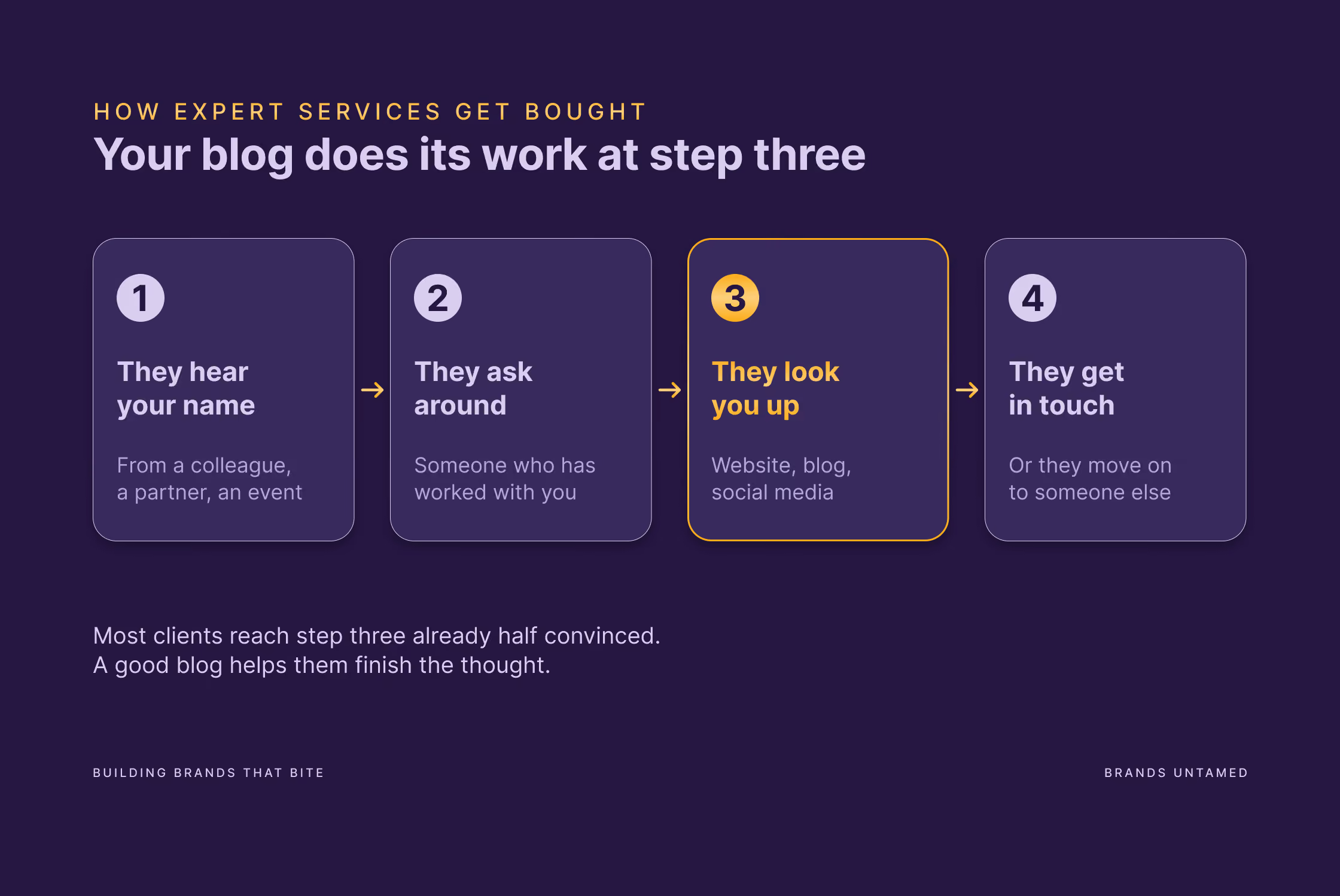
Because the people who hire you are a small group, and most of them aren't searching for you in the first place. Your writing has very little to do with it; this is simply how expert services get bought.
- Your market is small, and that's fine. If you advise packaging companies on sustainability rules, or design annual reports for Brussels associations, your potential clients number in the hundreds. Hundreds of people don't create search volume. You don't need them to.
- Buyers of expert services usually don’t start on Google. In our experience they ask a colleague, go back to someone they’ve worked with, follow a partner’s recommendation, or remember a name from a conference or a LinkedIn post. The search comes later, to check you out.
- AI answers now sit above the search results. Ask a general question like what makes a good report, and Google or ChatGPT answers it on the spot. Fewer people click through to any article at all.
- General topics belong to big sites. When a dozen software companies and agencies have already written how to brief a designer, a two-person studio won't outrank them. We know, because we tried.
So what is a company blog for?
A blog is proof of what you know, written down before anyone asks for it. For a small team, it does four useful jobs.
- It backs up the first impression. When someone hears your name from a colleague, they look you up. A recent, well-argued article tells them you're active and you know the territory. A blog whose last post is from 2023 is the website version of a 2023 calendar still hanging on the wall.
- It answers the same question so you don’t have to answer it again. If a client asks you something three times a year, it deserves an article. Next time, you send a link instead of writing a rushed email at 6pm.
- It gives AI tools something to quote. More buyers now ask ChatGPT or Perplexity before they ask a person. Those tools quote sources that give a precise answer, which is why our guide to getting your brand cited by AI puts so much weight on specifics.
- It makes you put your method into words. Explaining your approach in writing is good practice for explaining it to a client across the table.
If writing about your own expertise feels a bit like showing off, you're in good company. We wrote about that in personal branding for leaders who hate self-promotion.

How often should you publish?
Once a month is enough for most specialist businesses, as long as you can keep it up in your busiest month.
Weekly publishing is the standard advice, and it suits businesses that live on search traffic. For a team that wins work through reputation, the price is steep. A good article takes us almost a full day from idea to publication, including research, writing, visuals and a second pair of eyes. Every week, that's a serious slice for a two-person studio. So we now publish every two to four weeks, a pace we can keep even when we’re busy. That’s the plan, anyway.
If you’re working out your own pace, here’s what we’d suggest:
- Choose a rhythm for your worst month, not your best. A pace you can only keep when things are quiet will break the first time things get busy.
- Don't promise a schedule in public. Nobody misses a weekly article they were never told to expect.
- Date your articles, and refresh the ones with laws or numbers in them. An out-of-date figure costs you more credibility than a missing article.
- Don’t worry too much about a pause. A few weeks of silence, like ours, does no harm. Two years of silence is a different story.
What makes an article worth writing?
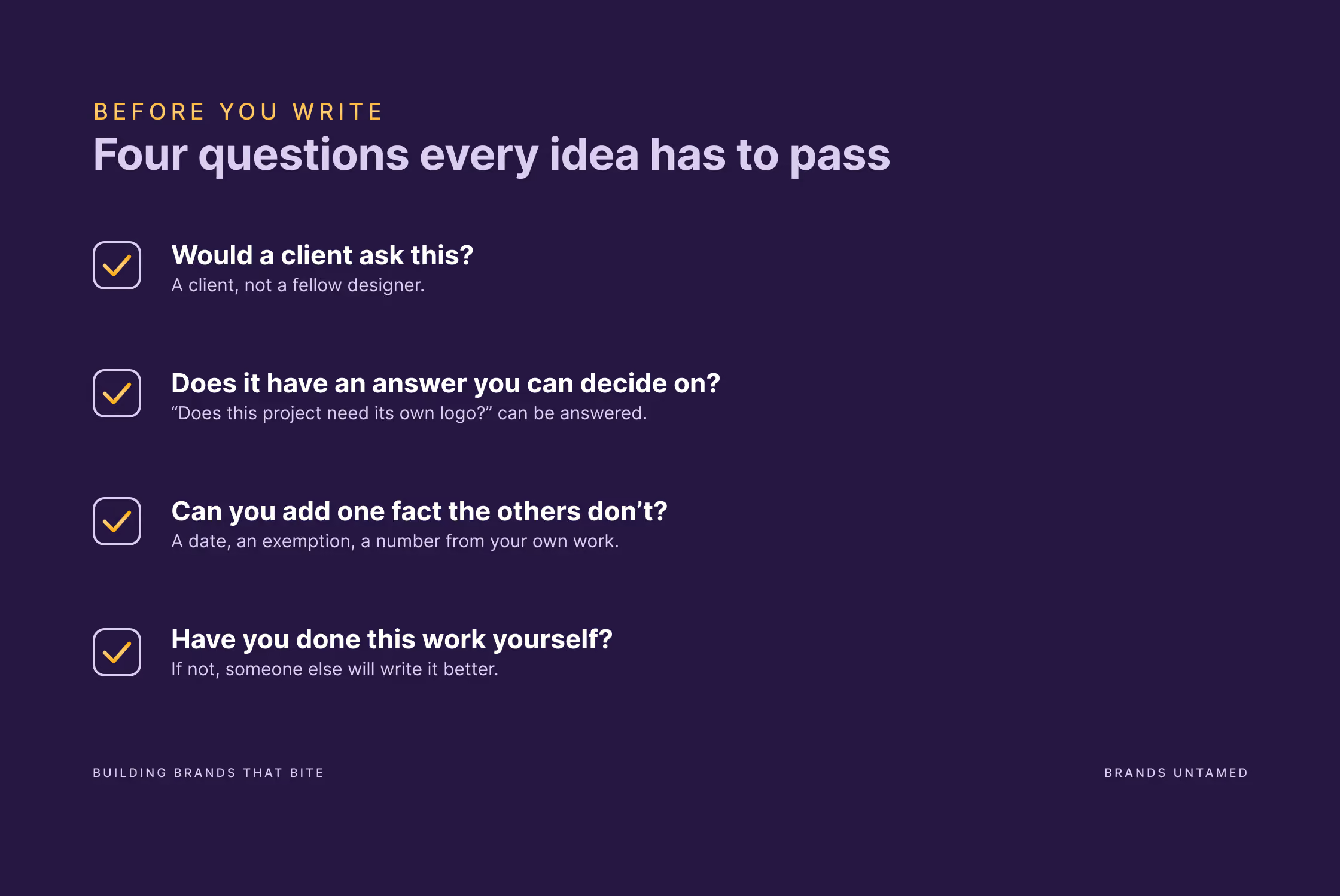
An article is worth writing when it answers a specific question your clients ask and adds one thing the other answers leave out. Since we started publishing less, we run every idea past four questions first.
- Would a client ask this? A client, not a fellow designer. Our Perplexity articles are among our most-read, and we’re proud of them, but they’re mostly read by people who use Perplexity rather than people who hire a brand studio. Our piece on preparing an association rebrand has fewer readers, but it was written for exactly the people who hire us.
- Does it have an answer you can decide on? Whether a project deserves its own logo can be answered. Why branding is important can't, or at least not in a way anyone remembers.
- Can we add one fact the others don't? A date, an exemption, a number from our own work, a mistake we made.
- Have we done this work ourselves? If we have, we can write details nobody else has. If we haven't, someone else will write it better.
If an idea passes all four, it’s worth a day of your time. If it doesn’t, it’s probably a to-do list item pretending to be content, which is the trap we described in stop treating content marketing as a to-do list.
FAQ
Is a company blog still worth it now that AI answers questions directly?
Yes, if your articles are specific. AI tools answer general questions themselves, but they still need sources for precise ones, and they quote the articles that give a clear, checkable answer.
How long should a blog article be?
Long enough to answer the question properly and no longer. Ours usually run between 1,500 and 2,000 words. Past that point, most readers start skimming.
Should a small business outsource its blog?
You can outsource the writing, but not the knowledge. A ghostwriter working from an hour's interview with you will produce something useful. A generic content service working from a keyword list will produce the same article everyone else already has.
Can we use AI to write our blog articles?
AI can help with structure, research and checking. The parts that make an article worth reading, your examples, your numbers and your opinions, have to come from you. Without them it reads like everyone else's.
How do you know if a blog is working?
Not by visitor numbers. Look at whether prospects mention an article, whether AI tools cite you, whether people forward your pieces to colleagues, and whether you find yourself sending links in client conversations.
Before you go
Whatever you decide about your blog, the people who hear your name will look you up first. If your brand doesn't yet show them who you are today, here's how to talk to us.
Not ready for that? Say hello to Hans or Ralu on LinkedIn, where we write about the same things in shorter form. (Possibly less often than we'd like, but we're working on it.)