


The annual report is one of the most predictable disasters in association comms. It eats 3-6 months, involves dozens of contributors across multiple countries, gets signed off by a board that's reviewing it for the first time two weeks before launch, and ends up as a PDF nobody opens.
Often the problem isn't design or content, but the production pipeline.
If you're a comms manager at a European federation or member association, here's the short version of what follows: most of the pain comes from decisions you don't realise you're making. The brief is treated as a content list. Contributors are treated as editors. The board is brought in at the wrong moment. Design is asked to fix things content couldn't. And distribution gets added at the end, when it should have been part of the original plan.
This article walks through the actual pipeline of getting an association annual report made, from the first planning meeting to "the file is live." Each phase has one decision that, if you get it right, prevents most of the downstream damage. We've written before about what makes a good report work in general, this is the association-specific companion. The principles still apply. The reality of producing it, though, is a different beast.
Phase 1: The plan that many teams skip
"Planning" the annual report usually means agreeing on a deadline.
That's not a plan, that's just scheduling.
Real planning answers one question: what is this report actually for? And the honest answer is rarely "to tell our members what we did last year." Most association annual reports are doing four jobs at once:
- A governance document for the board and statutory requirements
- A communications tool for members
- A credibility piece for external stakeholders (EU institutions, partners, press)
- A historical reference that lives on the website for years
Each one wants a different document. Pretending they're all the same one is where the project quietly goes wrong.
You don't have to make four documents. Most associations shouldn't. But you do need to decide which audience is primary and which ones the same document is also serving in a lighter way. That decision changes everything: the structure, the tone, the length, the format, the distribution, the budget split.
If you skip this conversation, you'll have it anyway. Just later, involving a lot more people, usually when something is already off and someone has to be told their bit isn't the priority. That's the version where it gets political.
The one decision: Which audience is this report primarily for? Everyone else is secondary.
Phase 2: The brief that prevents most of the pain
A brief is not a list of content.
Often the brief gets drafted as a list of sections: foreword, year in review, financials, member spotlights, etc. Then the team starts filling it in. Six weeks later, the document is twice as long as planned and nobody can agree on what to cut.
A real brief makes decisions before the work starts. Specifically:
- What's the primary audience, and what one thing should they take away?
- What's the format and where will people read it? Print and PDF? Web-first? An interactive microsite?
- What's the page count, and is it a ceiling or a target?
- What's the structure, and what's not in it?
- Who has authority on what? (Not who consults. Who decides.)
- What's the deadline, and what are the dates that work backwards from it?
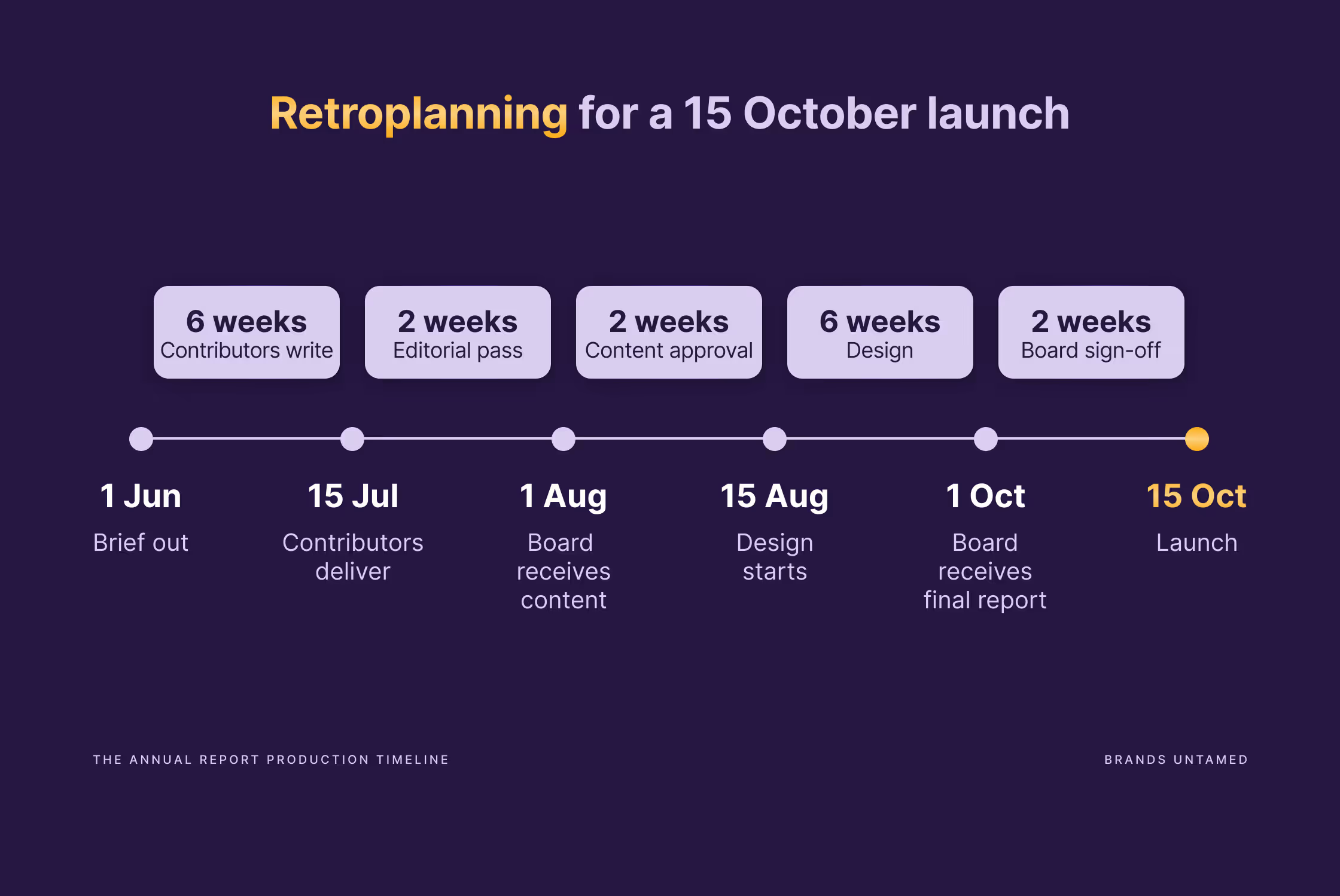
That last one matters more than people realise. If launch is 15 October and you need two weeks for board sign-off and two weeks for content approval, your design phase has to wrap by 1 October, which means design starts by 15 August, which means contributors deliver by 15 July, which means the brief goes out by 1 June.
Many associations work this out two months in, when it's already too late.
The one decision: Lock the timeline backwards from the launch date before the brief leaves your inbox. Everything else negotiates around that.
Phase 3: Contributors are not editors
Before you send the contributor brief, decide one thing: what are you asking each person for?
Finished copy you'll publish as-is? Raw input you'll rewrite? Data you'll turn into visuals?
Each one needs a different brief, a different template, a different deadline. "Please send your section by Friday" gets you thirty wildly different submissions that someone then has to spend a week rewriting. Decide upfront, and that week disappears.
Then there's the second mistake. Treating contributors as editors. A national delegate who runs a member organisation is a subject-matter expert. They're not a copywriter, or a design thinker. Asking them to "write your section in the right tone" is asking them to do a job they were never hired for.
The fix is simple but it requires an agreement: everything that comes back gets rewritten by the communications team. Not lightly edited. Properly rewritten, in one voice, by one person (or two).
The best contributor briefs ask for less. Three bullet points of what changed in 2026. Two numbers you want included. One quote, no longer than two sentences. The comms team turns that into the prose. Quality goes up, time goes down, everyone is happier.
The one decision: Decide what each contributor is for (writer, source, or data), brief them accordingly, and own the rewrite. More importantly, on the other side, members accept their contributions will not be used as-is.
Phase 4: Where design earns its place
Design often gets brought in too late.
The standard pattern: copy is "finalised," then handed to design for "layout." Design discovers structural problems that can only be fixed by re-editing the copy. Copy gets re-opened. Sign-off blows up. Everyone misses a deadline.
Design earns its money in the structure stage. The right moment to involve a designer is when you're sketching the document's shape, not when you've already decided what every page contains.
In practice, that means: a designer should be in the room (or on the call) when you're deciding the chapters. They'll ask questions like "is this a thirty-page document where the data does the work, or an eighty-page document where the storytelling does?" "Are we leading with the financials or burying them?" "If a board member only reads five pages, which five?" Those are design questions, even though they look like content questions. They determine how the document can be made well.
Once that's right, the layout phase moves quickly. When it's wrong, layout is where everyone discovers it.
There's a related point that's worth saying outright. Design is the moment where the report stops being a series of individual decisions and becomes one connected thing. Hierarchy, rhythm, signposting, summaries, white space,... none of that is decoration. It's the structure made visible. A reader who can navigate the document at a glance is a reader who'll come back to it. A reader who has to work too hard on page three closes it.
The one decision: Bring design in at the structure stage, not the layout stage. By the time you're counting page numbers it's already too late.
Phase 5: Sign-off without the bloodbath
The pattern: the report is finished. Designed, laid out, proofed. It goes to the board. Four directors come back with substantive comments. Two want sections re-ordered. One wants a different cover. The strategic priorities have apparently shifted since the brief was approved six months ago.
At this point you have two bad options: action the feedback and blow both your deadline and your budget (because your design rounds are already spent), or push back and navigate the politics alone.
Neither should have been on the table.
The fix is upstream and it's not glamorous. Design the governance into the timeline.
That means board-level approval should happen twice:
- once on a clean Word document before any design work begins, and
- once on the finished piece. At this stage, the scope of feedback is explicitly narrow: factual accuracy, statutory requirements, and last-pass typos. Not content changes.
When directors have approved content in writing at each stage, they rarely come back with structural comments at the end. And if they do, you have grounds to push back: changes after written approval mean additional budget, and that budget needs its own sign-off. It reframes the conversation from "comms being difficult" to "here are the consequences of changing course after approval." Most of what boards call design feedback at the final stage is content feedback in disguise anyway. Lock the content first and hire a good designer, and the final review is usually a formality.
If the board has never worked this way, the first year is the hard one. You have to set the expectation early ("we'd like to bring you in twice, at these moments, and here's why"). By year two it becomes the norm. By year three the board is wondering how they ever did it the old way.
Comms teams that own this process, and are confident enough to redirect feedback that arrives at the wrong stage, protect everyone: the timeline, the budget, and the board's own credibility.
The one decision: Get board involvement at two points before the final sign-off, with a defined scope for each.
Phase 6: Launch is part of the design, not the end of it
The default launch plan for an association annual report is: upload the PDF, send a newsletter, post on LinkedIn, done. That's a publication.
A launch is what happens before, during, and for six months after, with the report at the centre. It includes:
- A landing page on your website that's better than the PDF for someone who only wants the summary
- Member-segmented emails that surface the bits relevant to each segment
- A LinkedIn rollout, sequenced across two weeks, that mines the report for multiple posts
- A "year in numbers" social asset that lives independently from the report
- Internal briefings so your spokespeople can talk about it with confidence
- A dedicated launch moment (event, webinar, press briefing) for at least the strategic narrative
None of that is optional, but most of it can't be added at the end. The landing page needs to be designed alongside the report. The social cuts need to come from the structure. The member segmentation needs the right data captured in the content.
That's why launch should be a brief input. The question to ask at the start (not the end) of the project is: where will this report be shown, and what does each format need to look like to work well there?
Done right, you're not "launching the annual report" in October. You're publishing a coordinated set of communications, of which the full report is one piece. The PDF gets downloaded. The landing page gets shared. The social posts get forwarded. The report does its work in all the places people actually are.
The one decision: Plan the distribution at the brief stage. The full report is one format among several, not the only one.
Phase 7: What the report leaves behind
The annual report is the most expensive single document most associations produce. Treating it as one-off content is a small tragedy of resource allocation.
Done well, an annual report leaves three things behind that the next one can build on:
A working structure. If the chapter logic and information hierarchy worked this year, it should work next year too. Annual reports gain strength from year-on-year familiarity.
A library of reusable content blocks. Member spotlights, the way you handle financials, the way you present the year's strategic priorities: these are templates. Build them as a system, not as one-time deliverables.
A list of what didn't work. The contributor who delivered three weeks late. The chapter that ended up cut. The translation cycle that took twice as long. Write it down the week after launch, while it's still fresh. Next year's project plan starts there.
Associations that treat the annual report as a system get easier production, faster decisions, and better documents over time.
The one decision: Debrief within two weeks of launch, while the pain is fresh, and capture what worked and what didn't.
What changes when you do this
You won't get a perfect annual report. Nobody does. The variables are too many and too political.
What you will get is one that gets done on time, that the board signs off without a fight, and that members actually open. And a process that scales: year two is easier than year one, year three is easier than year two. The annual report stops being a recurring crisis and starts being a known quantity.
FAQ
How long does an annual report take, from kick-off to launch?
For a European federation with twenty or so contributing organisations, plan for four to six months. Less than that is possible, but it eats into board sign-off and translation time (if needed). More than that and the content goes stale before launch.
Should we do print, PDF, or web-first?
Depends on your audience. For most associations, web-first with a downloadable PDF is common. Print is used extensively as event collateral or for specific stakeholder briefings. Whatever you choose, decide it in Phase 1, not in Phase 4.
Do we really need a separate landing page?
If you want anyone outside your existing membership to read it, yes. The PDF is for people who already know who you are and want the details. The landing page is for everyone else.
Our board insists on reviewing the polished final version. How do we change that?
Slowly. Don't try to fight the existing sign-off in year one. Instead, add an earlier touchpoint ("we'd like to share the structure and key messages with you in June, before drafting") and frame it as a courtesy. By year two, that earlier review becomes the substantive one and the final pass narrows naturally.
What if our annual report has to be in three languages?
Plan for it from day one. Design has to work in expanded text (German, French) and condensed text (English). The brief specifies which language is authoritative for translation. Translation cycles get built into the timeline with the same rigour as sign-off cycles.
We're a small comms team. Can we do this in-house?
Yes, if you have a dedicated copywriter and a dedicated graphic designer. The strategic decisions, the contributor management, and the editorial pass are things that should stay in-house because they're about your organisation, not about craft. The structural design is where external support earns its place.