When to Hire a Studio, a Freelancer, or a Large Agency

May 28, 2026
Written by
Hans Gijbels
Scroll Down
When to Hire a Studio, a Freelancer, or a Large Agency

You've got a brand or creative project on your desk that you can't do in-house. The next question (studio, freelancer, or agency) often gets answered by gut feel, by who replied to the last email, or by whoever a colleague used six months ago. None of which are good reasons.

The short version: a senior freelancer is the right call when the work needs one expert pair of hands and your team has the capacity to direct them. A studio is the right call when you want senior people doing both the thinking and the making, and you'd rather not project-manage three suppliers to get there. A large agency is the right call when the brief needs scale, when procurement and legal need a supplier they recognise, or when your project will run across multiple markets and needs local-market account management you can't build yourself. The trade-offs aren't about capability, all three can do good work. But they're structured differently, so it’s about deciding which structure suits your situation.

Below is my honest take on that comparison, written for in-house marketing managers and directors who'd rather pick well the first time.

Before we start: this isn't about skill level

"Freelancer," "studio," and "agency" aren't skill levels. Each contains a wide range of seniority, and the trade-offs at the senior end are completely different from the trade-offs at the junior end.

A 15-year freelance creative director who used to run a brand team is a different product to a freelancer two years out of agency life charging €400 a day. A founder-led studio where the seniors do the work is a different product to a studio that's grown to ten people and where the founders mostly sell.  A large agency's pitch room is full of senior creative directors; the day-to-day delivery team often isn't.

When this article talks about a freelancer, a studio, or an agency, it assumes you're hiring at the senior end of each. The junior end is cheaper, you'll manage more of the work yourself, and the quality of the deliverable is less predictable. That's a legitimate trade-off for some projects. It's not what this article is about.

One more thing worth saying up front: the categories below describe how each model tends to be set up, not laws. Treat them as a starting point for thinking, not a scoring system.

The six structural differences that change the decision

These are the things that genuinely differ between the three models. Capability often overlaps. Structure doesn't.

1. How many people you're hiring, and what happens if one of them disappears

A freelancer is one person. If they get sick, go on holiday, or land a big client and disappear for a month, the work stops. That's not a flaw of freelancers, it's the model. The upside is that if they're excellent, every hour of the project is excellent. No handover loss, no version of the work made by someone less senior.

A studio is usually two to eight people, often with overlapping skills. If one person is on holiday or off sick, the others can usually keep things moving, but only just. It's still a small team, and you're typically working directly with the senior people throughout. 

A large agency has dozens to hundreds of people. If someone leaves, there's always someone to replace them and the work keeps moving. The natural trade-off for that scale is that day-to-day delivery runs through mid-weight and junior teams, with senior oversight rather than senior hands-on involvement. That works well for some briefs and less well for others. Let’s come back to this one.

2. Whether the people you meet are the people who do the work

This is a structural difference that catches a lot of marketing managers off guard.

When you hire a freelancer, the person you spoke to is the person who delivers. Same for most small studios: the founders pitch, the founders deliver, and any collaborators they might bring in work directly under their eye.

Large agencies are structured differently, and by necessity. Pitch teams are typically senior because that's the right level for scoping and selling complex work. Day-to-day delivery then runs through mid-weight and junior teams, with account management coordinating across the project. It's not a bait and switch, it's just how the model has to work at that scale.

For some projects this is fine, even ideal. A multi-market campaign with a clear creative platform needs lots of capable mid-weight hands, not three senior directors arguing about kerning. For more foundational work like a positioning rebuild or a brand system that has to last five years, it's worth understanding upfront who will actually be in the files day to day.

3. Where your budget actually goes

With a freelancer, you're paying for their time, almost entirely. Overheads are minimal: a laptop, a software stack, an accountant. The rate is what they need to live and reinvest.

With a small studio, you're paying for senior time plus modest overhead (tools, admin, a website, a small team to coordinate). Most of the budget still funds senior hands on your work.

With a large agency, your budget funds senior creative time, junior production time, account management, office infrastructure, software at scale, insurance, legal, and the agency's margin. A portion of any invoice reflects that overhead rather than hands directly on your project. 

That's not a complaint. The infrastructure is often what you're hiring them for. If you need rigorous procurement, ironclad GDPR documentation, multi-market invoicing, and a supplier your CFO can put on a preferred list, that infrastructure is the product. You couldn't get it from a freelancer if you tried. But if none of that matters for your project, you're paying for things that don't reach your work.

4. How they handle scope changes and the unexpected

Scope changes happen on every project. The interesting question is what happens when they do.

With a freelancer, it depends entirely on the individual and how the contract was written. Some freelancers absorb small changes without blinking. Others document every extra round meticulously, because they have to: their margin is thin.

With a studio, scope changes usually get handled in conversation. The team is small enough that everyone knows where the project is, the change request doesn't have to pass through three layers, and a sensible studio will absorb minor things and flag the big ones honestly.

With a large agency, scope changes go through a formal change-request process. There'll be a change order, sometimes a new statement of work, often a meeting with the account director. This is a feature if you're a buyer who needs a paper trail and budget protection. It can be friction if you're trying to move quickly.

5. What the relationship is

With a freelancer, you have a relationship with a person. It can run deep over years. It can also end, completely, if they take a full-time job or stop freelancing. 

With a studio, you have a relationship with a small team, usually anchored by the founders. The relationship tends to last because the founders aren't going anywhere, the studio is the thing they're building. You build up shared context: they know your sector, your internal politics, your CEO's allergies and their dog’s name. That context is hard to replicate.

With a large agency, the relationship is with the agency as an institution rather than with specific people. Account teams change over time, and when a senior person who knows your business well moves on, there's a handover process. The agency continues; the personal context has to be rebuilt.

6. Whether they can clear your procurement and legal hoops

This one is genuinely about scale, and it's often the deciding factor for large companies whether marketing leads talk about it openly or not. 

Freelancers vary wildly. Some have proper limited companies, professional indemnity insurance, GDPR-compliant contracts, and can invoice in multiple currencies. Others have none of that. Corporate procurement teams will often refuse to onboard a freelancer below a certain turnover threshold, regardless of how good their work is. 

Studios sit in between. Most established studios can satisfy reasonable procurement and legal requirements (insurance, NDAs, supplier questionnaires, GDPR documentation), but won't fit every corporate supplier framework. If your company has a strict policy of only working with suppliers above a certain revenue, a small studio probably won't clear it.

Large agencies are built for it. Master service agreements, six-figure insurance cover, dedicated legal teams, multi-currency invoicing, supplier diversity reporting, sustainability documentation, the lot. If your procurement process is heavy, this can be the single biggest factor in the decision, and it can be a legitimate one in some cases.

Studio Freelancer Agency comparison, by Brands Untamed

When a senior freelancer is the right call

A senior freelancer is the right call when:

  • The work needs one expert pair of hands, not a team.
  • You know exactly what you want and can brief tightly.
  • Your in-house team has the capacity to direct, review, and project-manage.
  • The single-point-of-failure risk is acceptable for this project.
  • Your procurement process can onboard an individual supplier without drama.

Typical fits: a senior copywriter to write your annual report, an experienced brand designer to extend an existing system into new applications, a strategist to facilitate a positioning workshop, a developer to build out a campaign microsite. Discrete, well-defined, deep-skill work where you don't need a second discipline involved.

The honest caveat: this only works if the freelancer is genuinely senior. A junior freelancer at the same hourly rate is a worse deal than the same money spent on a senior studio's time, because the management overhead eats the savings.

When a studio is the right call

A studio is the right call when:

  • You want senior thinking and senior execution from the same people.
  • The work spans more than one discipline, or might grow into more than one. Strategy and design, design and content, brand and web.
  • You don't want to spend your week project-managing three suppliers.
  • The relationship matters. You'd rather still be working with the same partners next year, with all the context that brings.
  • The brief might evolve. You want the flexibility to scope up or down without finding new people.

A studio is also often the right call for a contained, single-discipline brief if you'd rather pay slightly more for the team continuity and the senior eye throughout. Hiring a studio for "just" a design project isn't a misuse of the model; it's a choice to have senior eyes on the work rather than rolling the dice on a junior freelancer.

Typical fits: a full rebrand for a company that's outgrown its DIY identity and now needs strategy, visual system, and website built as one coherent asset. An association that needs its annual report, member campaigns, and event branding to feel like they come from the same organisation, year after year. A senior expert whose LinkedIn, website, and pitch deck currently look like three different people made them. Cross-discipline work where the strategy and the execution have to talk to each other constantly. 

Studios are usually slightly more expensive per hour than a freelancer, and it's worth understanding what you're actually buying. Even on a project where you only ever speak to one person, there's a second senior in the background who has seen the work before you have. Not an account manager checking timelines, a creative or strategic equal who can say "that's not good enough yet" before it leaves the building. Most clients never know that conversation happened. They just notice that the work arrives more considered, the recommendations feel more confident, and the things that usually need a second round somehow don’t anymore. That's what the rate reflects.

When a large agency is the right call

A large agency is the right call when:

  • The brief needs a large team running in parallel: think of a global campaign with creative, media buying, public affairs, production, and PR all moving at once.
  • You need formal procurement, legal, and supplier infrastructure. Master service agreements, large insurance cover, multi-market invoicing, supplier diversity reporting.
  • You need the institutional weight of a known agency name, internally or externally. Sometimes a CMO needs to walk into a board meeting and say a recognised name. That's a legitimate need.
  • Your project will run across multiple markets and needs local-market account management you can't build yourself.
  • Media buying is part of the brief, and you need an agency with the trading desks and rate cards to handle it at scale.

The large agency model exists because some briefs actually need it. If you're launching in eight European markets with synchronised creative, paid media, influencer activations, and PR, a small studio will struggle and a freelancer simply can't.

One thing worth knowing: at that scale, the senior people who shape the pitch won't be running your weekly status calls. That's not a problem if you know it going in. Ask early who'll be managing the day-to-day, get comfortable with that team, and if specific senior involvement matters for your project, make it part of the conversation before you sign.

A simple way to decide this afternoon

If you can answer these five questions honestly, the right model usually becomes obvious:

  1. How many disciplines does this brief actually need? One: freelancer or studio. Two or three: studio or agency. Four or more, in parallel, across markets: agency.
  2. How much of my own week can I spend managing this? Lots: freelancer is viable. Some to almost none: studio. Almost none, but I have an account management appetite: agency.
  3. What's my procurement situation? Light: any of the three. Heavy supplier requirements: studio or agency. Strict large-supplier-only policy: agency.
  4. How important is it that the same people are still here next year? Very: freelancer (if they don't move on), or studio. Less so: agency.
  5. What's my actual budget once I include my own time? This is the one most people skip. Do the math properly.

If the honest answers point you to a freelancer, hire the most senior one you can afford and brief them tightly. If they point to a studio, look for one where the founders do the work and you can talk to them directly. If they point to an agency, write the contract so the senior names you met at pitch are committed to your project by hours.
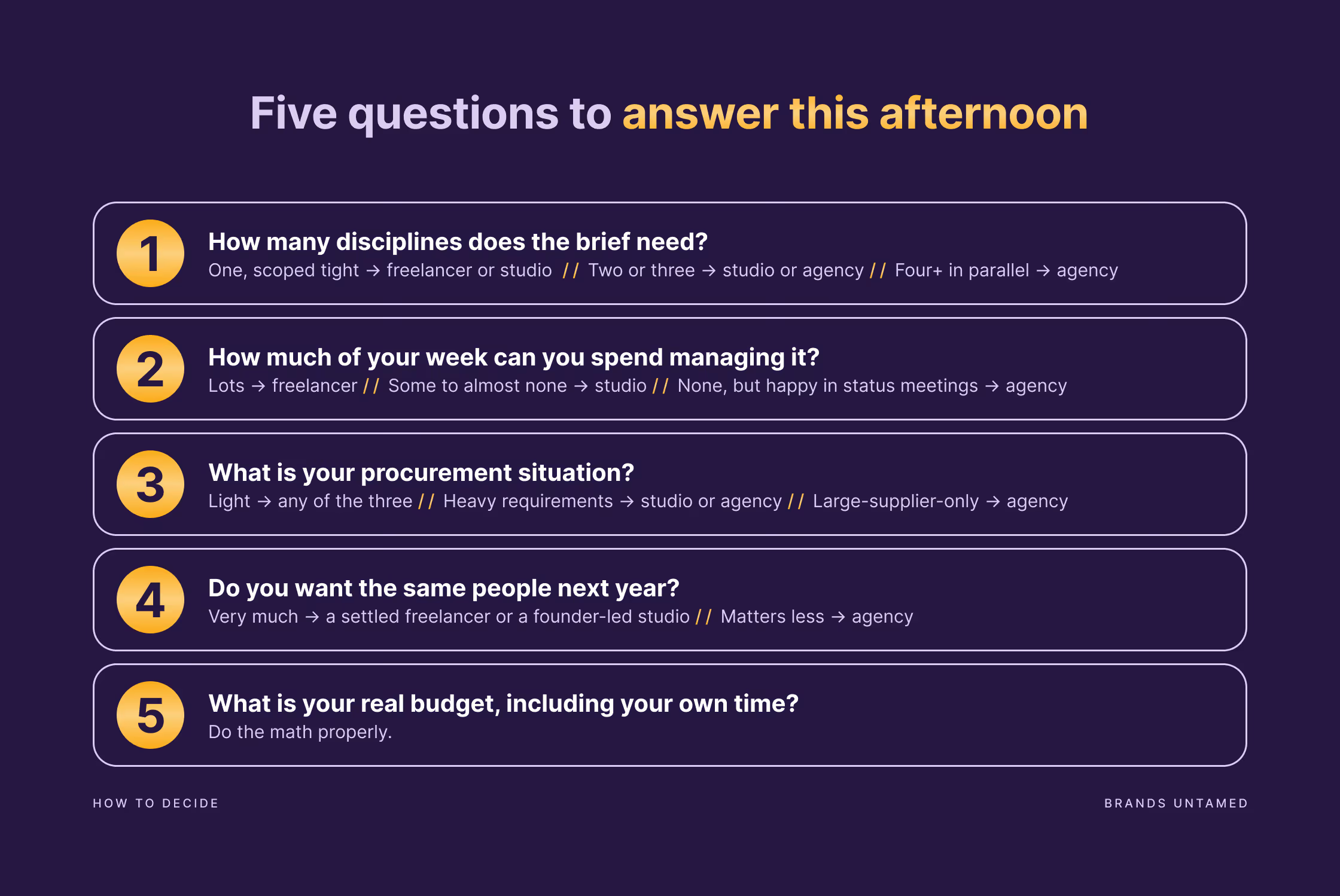
Five questions to decide which creative partner you need, by Brands Untamed

FAQ

Can a freelancer handle a full rebrand?

A senior freelancer with the right background absolutely can, particularly if the rebrand is mostly identity work rather than positioning and strategy. The question isn't whether they can; it's whether you have the bandwidth to direct them and absorb the single-point-of-failure risk. If your project has a hard deadline and the freelancer breaks an arm, the project stops. That's the trade-off.

Aren't studios just expensive freelancers?

Sometimes, yes. But what you're paying for at a real studio is the combination of senior people working alongside each other every day, the shared system and context, and the resilience that comes from more than one person carrying the work. It's also complementary disciplines under one roof: a strategist and a designer who've worked together long enough that the strategy already accounts for the design and vice versa. That's something even a brilliant freelancer with a network can't quite replicate. 

Is "boutique agency" the same as a studio?

Often, in practice, yes. The labels are mostly marketing. What matters is the structure: who's doing the work, how many people are on the team, where the budget goes, and whether the founders are still hands-on. Ask those questions and the label sorts itself out.

What's the right budget for each?

There's no useful answer to this in the abstract, because day rates vary too much by seniority, sector, and country. The more useful question is: for the budget you have, what's the most senior version of each model you can afford? Seniority predicts quality more reliably than the type of supplier. A senior freelancer will usually deliver better work than a junior studio, even though the studio sounds more substantial on paper. Start there. 

What if I get it wrong?

You'll know within the first month. The signals are clear: the work doesn't feel senior, the communication is slow, the project keeps slipping, or the person you signed with has disappeared into "oversight" while someone you've never met does the actual work. Cut early. The cost of changing suppliers in month two is a fraction of the cost of finishing a bad engagement in month six.

If any of this sounds familiar

Most marketing managers reading this will recognise their situation in one of the three options. If your project genuinely needs a large team, formal procurement, and multi-market account management, hire the right agency and write the contract carefully. If it needs one senior pair of hands and you've got the capacity to direct, find the right freelancer.

If it sits in the middle: senior thinking and senior execution from the same people, a relationship that lasts beyond a single project,... that's where a studio earns its slot. If that's the kind of work you're looking at, we'd be happy to talk it through with you.

Table of Contents

You've got a brand or creative project on your desk that you can't do in-house. The next question (studio, freelancer, or agency) often gets answered by gut feel, by who replied to the last email, or by whoever a colleague used six months ago. None of which are good reasons.

The short version: a senior freelancer is the right call when the work needs one expert pair of hands and your team has the capacity to direct them. A studio is the right call when you want senior people doing both the thinking and the making, and you'd rather not project-manage three suppliers to get there. A large agency is the right call when the brief needs scale, when procurement and legal need a supplier they recognise, or when your project will run across multiple markets and needs local-market account management you can't build yourself. The trade-offs aren't about capability, all three can do good work. But they're structured differently, so it’s about deciding which structure suits your situation.

Below is my honest take on that comparison, written for in-house marketing managers and directors who'd rather pick well the first time.

Before we start: this isn't about skill level

"Freelancer," "studio," and "agency" aren't skill levels. Each contains a wide range of seniority, and the trade-offs at the senior end are completely different from the trade-offs at the junior end.

A 15-year freelance creative director who used to run a brand team is a different product to a freelancer two years out of agency life charging €400 a day. A founder-led studio where the seniors do the work is a different product to a studio that's grown to ten people and where the founders mostly sell.  A large agency's pitch room is full of senior creative directors; the day-to-day delivery team often isn't.

When this article talks about a freelancer, a studio, or an agency, it assumes you're hiring at the senior end of each. The junior end is cheaper, you'll manage more of the work yourself, and the quality of the deliverable is less predictable. That's a legitimate trade-off for some projects. It's not what this article is about.

One more thing worth saying up front: the categories below describe how each model tends to be set up, not laws. Treat them as a starting point for thinking, not a scoring system.

The six structural differences that change the decision

These are the things that genuinely differ between the three models. Capability often overlaps. Structure doesn't.

1. How many people you're hiring, and what happens if one of them disappears

A freelancer is one person. If they get sick, go on holiday, or land a big client and disappear for a month, the work stops. That's not a flaw of freelancers, it's the model. The upside is that if they're excellent, every hour of the project is excellent. No handover loss, no version of the work made by someone less senior.

A studio is usually two to eight people, often with overlapping skills. If one person is on holiday or off sick, the others can usually keep things moving, but only just. It's still a small team, and you're typically working directly with the senior people throughout. 

A large agency has dozens to hundreds of people. If someone leaves, there's always someone to replace them and the work keeps moving. The natural trade-off for that scale is that day-to-day delivery runs through mid-weight and junior teams, with senior oversight rather than senior hands-on involvement. That works well for some briefs and less well for others. Let’s come back to this one.

2. Whether the people you meet are the people who do the work

This is a structural difference that catches a lot of marketing managers off guard.

When you hire a freelancer, the person you spoke to is the person who delivers. Same for most small studios: the founders pitch, the founders deliver, and any collaborators they might bring in work directly under their eye.

Large agencies are structured differently, and by necessity. Pitch teams are typically senior because that's the right level for scoping and selling complex work. Day-to-day delivery then runs through mid-weight and junior teams, with account management coordinating across the project. It's not a bait and switch, it's just how the model has to work at that scale.

For some projects this is fine, even ideal. A multi-market campaign with a clear creative platform needs lots of capable mid-weight hands, not three senior directors arguing about kerning. For more foundational work like a positioning rebuild or a brand system that has to last five years, it's worth understanding upfront who will actually be in the files day to day.

3. Where your budget actually goes

With a freelancer, you're paying for their time, almost entirely. Overheads are minimal: a laptop, a software stack, an accountant. The rate is what they need to live and reinvest.

With a small studio, you're paying for senior time plus modest overhead (tools, admin, a website, a small team to coordinate). Most of the budget still funds senior hands on your work.

With a large agency, your budget funds senior creative time, junior production time, account management, office infrastructure, software at scale, insurance, legal, and the agency's margin. A portion of any invoice reflects that overhead rather than hands directly on your project. 

That's not a complaint. The infrastructure is often what you're hiring them for. If you need rigorous procurement, ironclad GDPR documentation, multi-market invoicing, and a supplier your CFO can put on a preferred list, that infrastructure is the product. You couldn't get it from a freelancer if you tried. But if none of that matters for your project, you're paying for things that don't reach your work.

4. How they handle scope changes and the unexpected

Scope changes happen on every project. The interesting question is what happens when they do.

With a freelancer, it depends entirely on the individual and how the contract was written. Some freelancers absorb small changes without blinking. Others document every extra round meticulously, because they have to: their margin is thin.

With a studio, scope changes usually get handled in conversation. The team is small enough that everyone knows where the project is, the change request doesn't have to pass through three layers, and a sensible studio will absorb minor things and flag the big ones honestly.

With a large agency, scope changes go through a formal change-request process. There'll be a change order, sometimes a new statement of work, often a meeting with the account director. This is a feature if you're a buyer who needs a paper trail and budget protection. It can be friction if you're trying to move quickly.

5. What the relationship is

With a freelancer, you have a relationship with a person. It can run deep over years. It can also end, completely, if they take a full-time job or stop freelancing. 

With a studio, you have a relationship with a small team, usually anchored by the founders. The relationship tends to last because the founders aren't going anywhere, the studio is the thing they're building. You build up shared context: they know your sector, your internal politics, your CEO's allergies and their dog’s name. That context is hard to replicate.

With a large agency, the relationship is with the agency as an institution rather than with specific people. Account teams change over time, and when a senior person who knows your business well moves on, there's a handover process. The agency continues; the personal context has to be rebuilt.

6. Whether they can clear your procurement and legal hoops

This one is genuinely about scale, and it's often the deciding factor for large companies whether marketing leads talk about it openly or not. 

Freelancers vary wildly. Some have proper limited companies, professional indemnity insurance, GDPR-compliant contracts, and can invoice in multiple currencies. Others have none of that. Corporate procurement teams will often refuse to onboard a freelancer below a certain turnover threshold, regardless of how good their work is. 

Studios sit in between. Most established studios can satisfy reasonable procurement and legal requirements (insurance, NDAs, supplier questionnaires, GDPR documentation), but won't fit every corporate supplier framework. If your company has a strict policy of only working with suppliers above a certain revenue, a small studio probably won't clear it.

Large agencies are built for it. Master service agreements, six-figure insurance cover, dedicated legal teams, multi-currency invoicing, supplier diversity reporting, sustainability documentation, the lot. If your procurement process is heavy, this can be the single biggest factor in the decision, and it can be a legitimate one in some cases.

Studio Freelancer Agency comparison, by Brands Untamed

When a senior freelancer is the right call

A senior freelancer is the right call when:

  • The work needs one expert pair of hands, not a team.
  • You know exactly what you want and can brief tightly.
  • Your in-house team has the capacity to direct, review, and project-manage.
  • The single-point-of-failure risk is acceptable for this project.
  • Your procurement process can onboard an individual supplier without drama.

Typical fits: a senior copywriter to write your annual report, an experienced brand designer to extend an existing system into new applications, a strategist to facilitate a positioning workshop, a developer to build out a campaign microsite. Discrete, well-defined, deep-skill work where you don't need a second discipline involved.

The honest caveat: this only works if the freelancer is genuinely senior. A junior freelancer at the same hourly rate is a worse deal than the same money spent on a senior studio's time, because the management overhead eats the savings.

When a studio is the right call

A studio is the right call when:

  • You want senior thinking and senior execution from the same people.
  • The work spans more than one discipline, or might grow into more than one. Strategy and design, design and content, brand and web.
  • You don't want to spend your week project-managing three suppliers.
  • The relationship matters. You'd rather still be working with the same partners next year, with all the context that brings.
  • The brief might evolve. You want the flexibility to scope up or down without finding new people.

A studio is also often the right call for a contained, single-discipline brief if you'd rather pay slightly more for the team continuity and the senior eye throughout. Hiring a studio for "just" a design project isn't a misuse of the model; it's a choice to have senior eyes on the work rather than rolling the dice on a junior freelancer.

Typical fits: a full rebrand for a company that's outgrown its DIY identity and now needs strategy, visual system, and website built as one coherent asset. An association that needs its annual report, member campaigns, and event branding to feel like they come from the same organisation, year after year. A senior expert whose LinkedIn, website, and pitch deck currently look like three different people made them. Cross-discipline work where the strategy and the execution have to talk to each other constantly. 

Studios are usually slightly more expensive per hour than a freelancer, and it's worth understanding what you're actually buying. Even on a project where you only ever speak to one person, there's a second senior in the background who has seen the work before you have. Not an account manager checking timelines, a creative or strategic equal who can say "that's not good enough yet" before it leaves the building. Most clients never know that conversation happened. They just notice that the work arrives more considered, the recommendations feel more confident, and the things that usually need a second round somehow don’t anymore. That's what the rate reflects.

When a large agency is the right call

A large agency is the right call when:

  • The brief needs a large team running in parallel: think of a global campaign with creative, media buying, public affairs, production, and PR all moving at once.
  • You need formal procurement, legal, and supplier infrastructure. Master service agreements, large insurance cover, multi-market invoicing, supplier diversity reporting.
  • You need the institutional weight of a known agency name, internally or externally. Sometimes a CMO needs to walk into a board meeting and say a recognised name. That's a legitimate need.
  • Your project will run across multiple markets and needs local-market account management you can't build yourself.
  • Media buying is part of the brief, and you need an agency with the trading desks and rate cards to handle it at scale.

The large agency model exists because some briefs actually need it. If you're launching in eight European markets with synchronised creative, paid media, influencer activations, and PR, a small studio will struggle and a freelancer simply can't.

One thing worth knowing: at that scale, the senior people who shape the pitch won't be running your weekly status calls. That's not a problem if you know it going in. Ask early who'll be managing the day-to-day, get comfortable with that team, and if specific senior involvement matters for your project, make it part of the conversation before you sign.

A simple way to decide this afternoon

If you can answer these five questions honestly, the right model usually becomes obvious:

  1. How many disciplines does this brief actually need? One: freelancer or studio. Two or three: studio or agency. Four or more, in parallel, across markets: agency.
  2. How much of my own week can I spend managing this? Lots: freelancer is viable. Some to almost none: studio. Almost none, but I have an account management appetite: agency.
  3. What's my procurement situation? Light: any of the three. Heavy supplier requirements: studio or agency. Strict large-supplier-only policy: agency.
  4. How important is it that the same people are still here next year? Very: freelancer (if they don't move on), or studio. Less so: agency.
  5. What's my actual budget once I include my own time? This is the one most people skip. Do the math properly.

If the honest answers point you to a freelancer, hire the most senior one you can afford and brief them tightly. If they point to a studio, look for one where the founders do the work and you can talk to them directly. If they point to an agency, write the contract so the senior names you met at pitch are committed to your project by hours.

Five questions to decide which creative partner you need, by Brands Untamed

FAQ

Can a freelancer handle a full rebrand?

A senior freelancer with the right background absolutely can, particularly if the rebrand is mostly identity work rather than positioning and strategy. The question isn't whether they can; it's whether you have the bandwidth to direct them and absorb the single-point-of-failure risk. If your project has a hard deadline and the freelancer breaks an arm, the project stops. That's the trade-off.

Aren't studios just expensive freelancers?

Sometimes, yes. But what you're paying for at a real studio is the combination of senior people working alongside each other every day, the shared system and context, and the resilience that comes from more than one person carrying the work. It's also complementary disciplines under one roof: a strategist and a designer who've worked together long enough that the strategy already accounts for the design and vice versa. That's something even a brilliant freelancer with a network can't quite replicate. 

Is "boutique agency" the same as a studio?

Often, in practice, yes. The labels are mostly marketing. What matters is the structure: who's doing the work, how many people are on the team, where the budget goes, and whether the founders are still hands-on. Ask those questions and the label sorts itself out.

What's the right budget for each?

There's no useful answer to this in the abstract, because day rates vary too much by seniority, sector, and country. The more useful question is: for the budget you have, what's the most senior version of each model you can afford? Seniority predicts quality more reliably than the type of supplier. A senior freelancer will usually deliver better work than a junior studio, even though the studio sounds more substantial on paper. Start there. 

What if I get it wrong?

You'll know within the first month. The signals are clear: the work doesn't feel senior, the communication is slow, the project keeps slipping, or the person you signed with has disappeared into "oversight" while someone you've never met does the actual work. Cut early. The cost of changing suppliers in month two is a fraction of the cost of finishing a bad engagement in month six.

If any of this sounds familiar

Most marketing managers reading this will recognise their situation in one of the three options. If your project genuinely needs a large team, formal procurement, and multi-market account management, hire the right agency and write the contract carefully. If it needs one senior pair of hands and you've got the capacity to direct, find the right freelancer.

If it sits in the middle: senior thinking and senior execution from the same people, a relationship that lasts beyond a single project,... that's where a studio earns its slot. If that's the kind of work you're looking at, we'd be happy to talk it through with you.