

Your LinkedIn profile is probably not getting the attention it deserves. Why? Because filling it in is not the same as positioning yourself.
A partner at a consulting firm, a Secretary-General at a European association, a finance executive moving into advisory work, a founder who spent a decade building something serious: all of them tend to have a profile that technically exists. The photo is there. The job history is there. Maybe even a summary. But the profile reads like a CV printout, not like the person who walks into a room and commands it.
This article is the tactical companion to our previous article on Personal Branding for Leaders Who Hate Self-Promotion. That piece covers the mindset. This one goes section-by-section: what to look at, what most senior experts get wrong, and what the stronger version looks like.
The profile that undersells you
The problem is rarely that a senior expert has “done nothing” with their profile. But what they've done often reads as one level below where they actually operate.
Take a policy director at a Brussels-based federation who spent fifteen years shaping European legislation. Their LinkedIn headline says: Policy Director at [Organisation Name]. Their About section opens with: I am an experienced policy professional with expertise in...
Nothing wrong with any of it. Nothing right either. Nothing that would make a stakeholder, journalist, or potential partner stop and think: this is exactly who I need to speak to.
The difference between who someone is and how their profile reads is almost never about a lack of achievements. But how those achievements get communicated - or don’t.
Three things cause this consistently:
- The job title trap. Roles describe what you are, not what you do or what you bring. A headline that is just a title is a wasted line.
- The CV instinct. Many people write their About section the way they'd write a cover letter in 2004: chronological, formal, third-person or stiff first-person, leading with credentials instead of perspective.
- Lack of maintenance. The profile was set up once and never properly revisited. It now reflects a version of the person from two or three roles ago.
The sections below address these problems directly.
The headline: where seniority gets lost first
LinkedIn gives you 220 characters for your headline (and up to 240 on the mobile app). Most senior experts use about 40 of them, on a job title.
Managing Partner | ABC Consulting
That's a business card. It tells someone your role and your employer. It tells them nothing about your expertise, your point of view, or why they would want to speak to you rather than any other managing partner at any other consulting firm.
A title describes a position; a headline describes a person.
The better version of that headline might be:
Helping mid-market companies untangle operational complexity | Managing Partner at ABC Consulting
Or, for an association leader:
Representing 200+ European food businesses at EU level | Secretary-General at [Federation Name]
Or for a founder transitioning into advisory:
20 years building and exiting technology businesses | Now advising founders on the parts that usually go wrong
In each case, the title is still there, for legitimacy and searchability. But the leading clause does the actual positioning work. It tells someone, within three seconds, what this person offers and who they’re for.
Three practical tests for your headline:
- Could this headline belong to anyone else in your role, at any other organisation? If yes, it needs work.
- Does it lead with what you offer or what you've achieved, or only with what you're called?
- Does it make a stakeholder or prospective client want to read further?
One more thing: LinkedIn's algorithm uses the headline for search ranking. A headline that includes relevant keywords (natural, not stuffed) will surface your profile more often in the right searches. A title-only headline is effectively invisible to anyone who doesn't already know your name.
The About section: a positioning statement, not a CV summary
The About section should answer one question for the person reading it: why does this person's work matter, and what do they actually do? Instead, many About sections answer a different question: what has this person done, in reverse chronological order?
The result reads like a press release about someone who isn't in the room. Formal. Backward-looking. Full of phrases like “with over X years of experience” and a “proven track record in”.
The About section is the one place on LinkedIn where you control the narrative. Use it.
What a strong About section does:
- Opens with a perspective, a problem you solve, or a clear statement of what you're for. Not with your credentials
- Speaks to a reader, not about yourself in the abstract
- Moves from what you do to why it matters to who it's for
- Ends with something actionable: what the reader should do next, or what you're open to
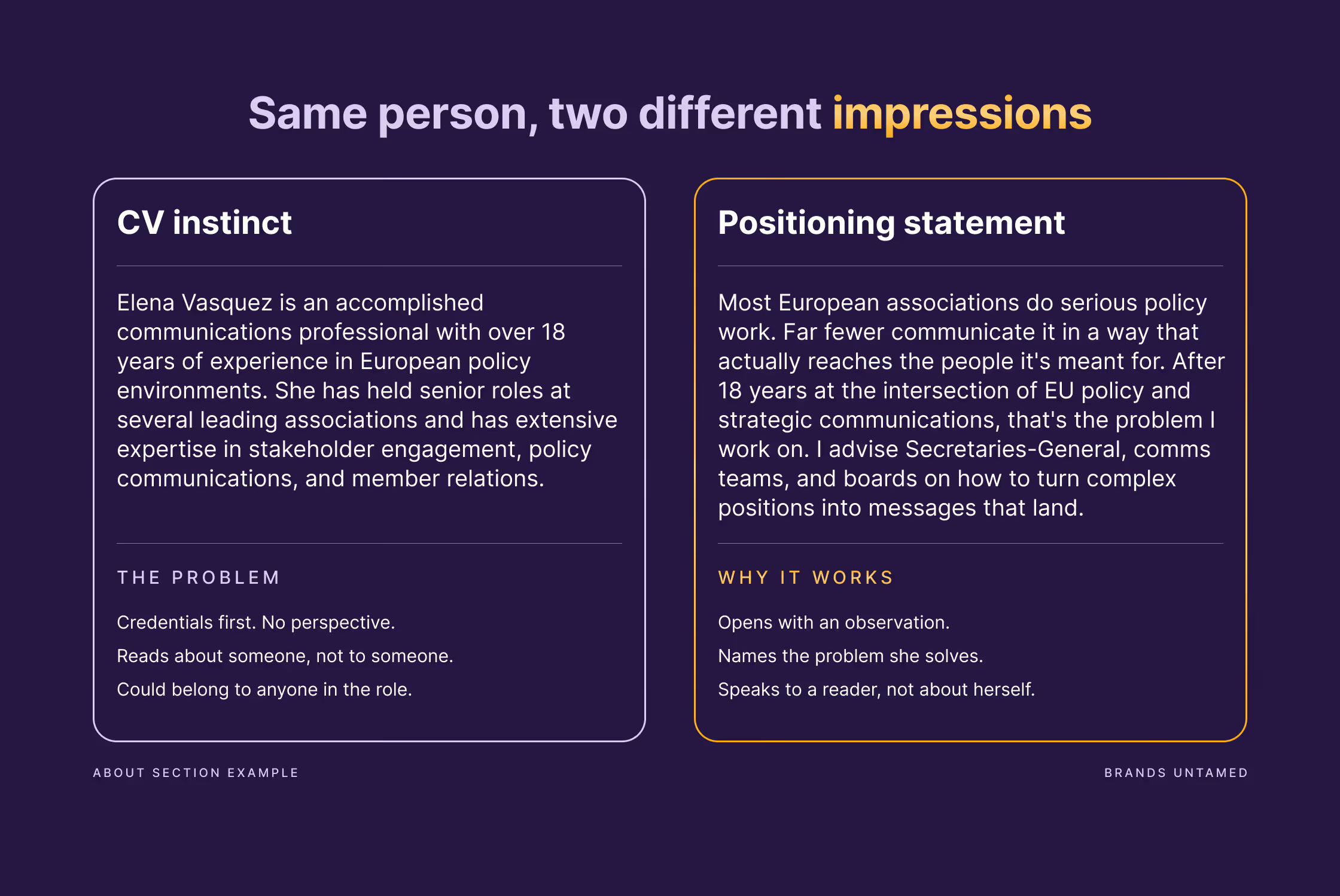
Here’s the difference in practice. A corporate communications executive's About section might say:
Elena Vasquez is an accomplished communications professional with over 18 years of experience in European policy environments. She has held senior roles at several leading associations and has extensive expertise in stakeholder engagement, policy communications, and member relations.
A better version could be:
Most European associations do serious policy work. Far fewer communicate it in a way that actually reaches the people it's meant for. After 18 years at the intersection of EU policy and strategic communications, that's the problem I work on. I advise Secretaries-General, communications teams, and boards on how to turn complex policy positions into messages that land with members, institutions, and the press.
The second version is more personal, more direct, and significantly more useful to anyone who reads it. It tells you what Elena does, who it's for, what her perspective is, and implicitly, why she's worth speaking to.
A few technical notes:
- The first few lines are what shows before the "See more" cut on mobile. Make those lines count.
- Write in the first person. Third person in an About section reads as self-important.
- Avoid bullet lists in this section. It's a narrative space; use it as one.
The visual layer: what your photo, banner, and featured section say before anyone reads a word
Visitors to your profile form an impression in roughly ten seconds. A significant portion of that impression comes from visuals, before a single word of your About section gets read.
The photo
A good professional photo doesn’t need to be expensive or studio-produced. It does need to be:
- Recent (within the last two or three years, ideally)
- Well-lit and in focus
- Cropped right (face and shoulders filling most of the frame)
- Consistent with the level at which you operate
That last point gets ignored often. A blurry conference crop from 2018 sends a signal, whether you intend it to or not. So does a casual selfie on someone who wants to be taken seriously as an advisor or board member.
The photo is also a consistency signal. If your organisation has a defined visual style, or if you appear regularly on panels and in publications, your photo should feel like it belongs to the same person.
The banner
The default blue LinkedIn banner is the visual equivalent of a blank wall. It says: this person hasn’t made a decision here.
Your banner doesn’t always need to be elaborate. A strong colour from your organisation's palette, your name and title set cleanly in type, or a simple image that reflects your sector. Any of these is better than default. For association leaders, it's also an opportunity for institutional alignment: using the organisation's visual identity in the banner signals that this person represents something, not just themselves. (If your organisation's visual identity is not yet consistent enough to carry into individual profiles, this article explains where to start.)
The featured section
Leaving this empty is a significant missed opportunity.
The featured section sits directly below the About section and is prime real estate. It's where you put the things that prove the About section is true. That might be:
- A recent article or report you contributed to
- A media appearance, interview, or panel recording
- A publication, white paper, or policy document
- A key project or milestone
For an association leader, linking to a landmark policy paper or a well-designed annual report here is far more useful than a generic reshared post. For a founder, linking to a press piece about an exit or a TEDx talk lands differently than nothing. For a corporate executive it could be a board appointment, a panel recording, or a piece of press coverage.
Two or three items, well-chosen, is enough.

Experience and skills: what to cut, not just what to add
The instinct when updating a LinkedIn profile is additive: add the new role, add the new responsibilities, add more keywords. The more useful edit is often subtractive.
Experience
For senior professionals, the experience section can easily become an archaeological dig through every role since graduation. Most of that detail isn’t useful to anyone reading it now.
A rough principle: the further back the role, the less detail it needs. A role from fifteen years ago can be one or two lines, or even just the title and employer. The weight should sit on the last ten years, where your current positioning is built.
Also worth reviewing: the language used for responsibilities. Most experience sections are written in passive or impersonal constructions: Responsible for managing a team of..., Led initiatives related to..., Worked across...
Stronger versions use active, specific language: A founder writes "Took the company from 4 to 23 clients in 18 months without outside funding." A corporate executive writes "Built a 12-person communications team from scratch across three markets." An association leader writes "Negotiated amendments on three major pieces of EU legislation."
Numbers and specifics earn credibility in a way that vague competency language never does.
Skills
The skills section is both underused and overused, often simultaneously. Senior experts tend to either ignore it entirely or list 50 generic competencies that could apply to anyone in any sector.
Keep it to fifteen or fewer skills, and make sure the top three (the ones you want to be found for and known for) are prominent. Endorsements from credible people matter here more than volume.
Worth knowing: LinkedIn's search algorithm weighs the skills section when surfacing profiles. If someone searches for a "corporate communications advisor" or a "brand strategist for associations," your skills listing is part of what determines whether you show up.
The activity signal: what your posts say before anyone reads them
When someone visits your profile, one of the first things they notice (after the photo and headline) is whether you've been active recently.
A profile with no posts in eight months reads as inactive. It raises a question: is this person still engaged? Still relevant? Still paying attention?
This is the part of the audit that makes most senior professionals uncomfortable, because it can feel like pressure to become a content machine. It’s not.
As we covered in the personal branding piece, consistency matters far more than volume. One substantive post every two weeks is enough to signal presence and perspective. That’s thirty minutes of work, twice a month.
What counts as substantive at a senior level:
- A short reflection after a conference, board meeting, or policy development
- A clear opinion on something happening in your sector
- A recommendation or observation: a book, a report, an idea worth sharing
- A milestone or announcement, written with the "so what" included
What does not count, and can actively undermine credibility:
- Inspirational quotes disconnected from any expertise
- Reshares with no comment added
- Engagement-bait prompts ("Drop a 1 in the comments if you agree")
On commenting
LinkedIn's algorithm rewards commenting as well as posting, and most advice you'll find on the platform tells you to comment consistently on other people's posts to grow your reach.
That's accurate. Commenting does build visibility, and for people actively trying to grow an audience, it's a real lever.
But the honest version of this, for a senior expert who doesn’t want to spend an hour a day on LinkedIn engagement: selective, substantive comments matter more than volume. Three well-considered comments a week on posts from your sector (comments that add a point of view rather than just affirming the original post) will do more for your profile than daily generic responses.
If systematic commenting feels like the part of this that you'll skip, that's fine. A sharp profile and regular posts will still do the work. The algorithm is one factor; the impression formed by a human visitor who lands on your profile is another.
A word on consistency across your organisation
For Secretaries-General, policy directors, and senior executives representing institutions, there’s an additional layer worth considering: visual and tonal consistency between individual profiles and the corporate presence.
I don’t mean that everyone's profile should look identical. I mean that the same professionalism and intentionality that goes into the organisation's LinkedIn page, should show up in the profiles of the people who represent it.
In practice: shared visual language in banners, consistent headline framing, and topic pillars that align with the organisation's communications priorities rather than pulling in unrelated directions.
A communications director at a European association once described it as the difference between an orchestra and a group of musicians who happen to be in the same room. The individual voices are still distinct (and they should be!) but there's a common key.
If you manage a communications team and you’re responsible for leadership visibility across multiple profiles, a short internal style guide for LinkedIn profiles is worth the two hours it takes to produce.
FAQ
How long should my LinkedIn About section be?
Between 150 and 300 words is the practical range for a senior expert. Long enough to establish perspective and context, short enough to be read. If it runs longer, cut rather than compress: a shorter, sharper section works better than a long one that people don't finish.
Should I write my About section in first person or third person?
First person, always. Third person in an About section reads as formal to the point of cold, and slightly as if a press officer wrote it for you. First person is more human, more direct, and easier to read.
How often should I update my LinkedIn profile?
Review it once a year as a minimum, and whenever something significant changes: a new role, a major project, a publication, a change in what you offer. The experience section often falls behind first; the About section tends to go stale second.
Do I need a custom banner?
Not a professionally designed one, necessarily. A clean image or a solid colour with your name and title is enough to move from "default" to "intentional."
Do LinkedIn recommendations still matter?
Yes, more than most people realise. Two or three well-written recommendations from credible people in your sector carry real weight. A recommendation from a board chair, a long-term client, or a respected peer is a third-party credibility signal that no amount of self-authored copy can replicate. Ask for them selectively and specifically.
Is commenting or posting more important on LinkedIn?
Posting matters more for positioning; commenting matters more for reach. If you only have time for one, post. If you do both, keep comments substantive: add a point of view, not just agreement.
My profile hasn't been updated in years. Where do I start?
Headline first. It's the highest-traffic element of your profile and the fastest to fix. Then the About section. Then the photo if it's out of date. Do those three and you’ll have done 80% of the work.
Next steps
If this raised more questions about where your profile actually stands, the Personal Branding for Leaders Who Hate Self-Promotion piece covers the strategic layer underneath: the positioning decisions that determine what your profile should say before you start writing.
If you manage a team and need this at scale, across multiple leadership profiles and aligned with an institutional communications strategy, that’s exactly the kind of work we do at Brands Untamed. Get in touch if you'd like to talk it through.


.avif)


