Why Association Communication Fails, and It’s Not Because of the Newsletter


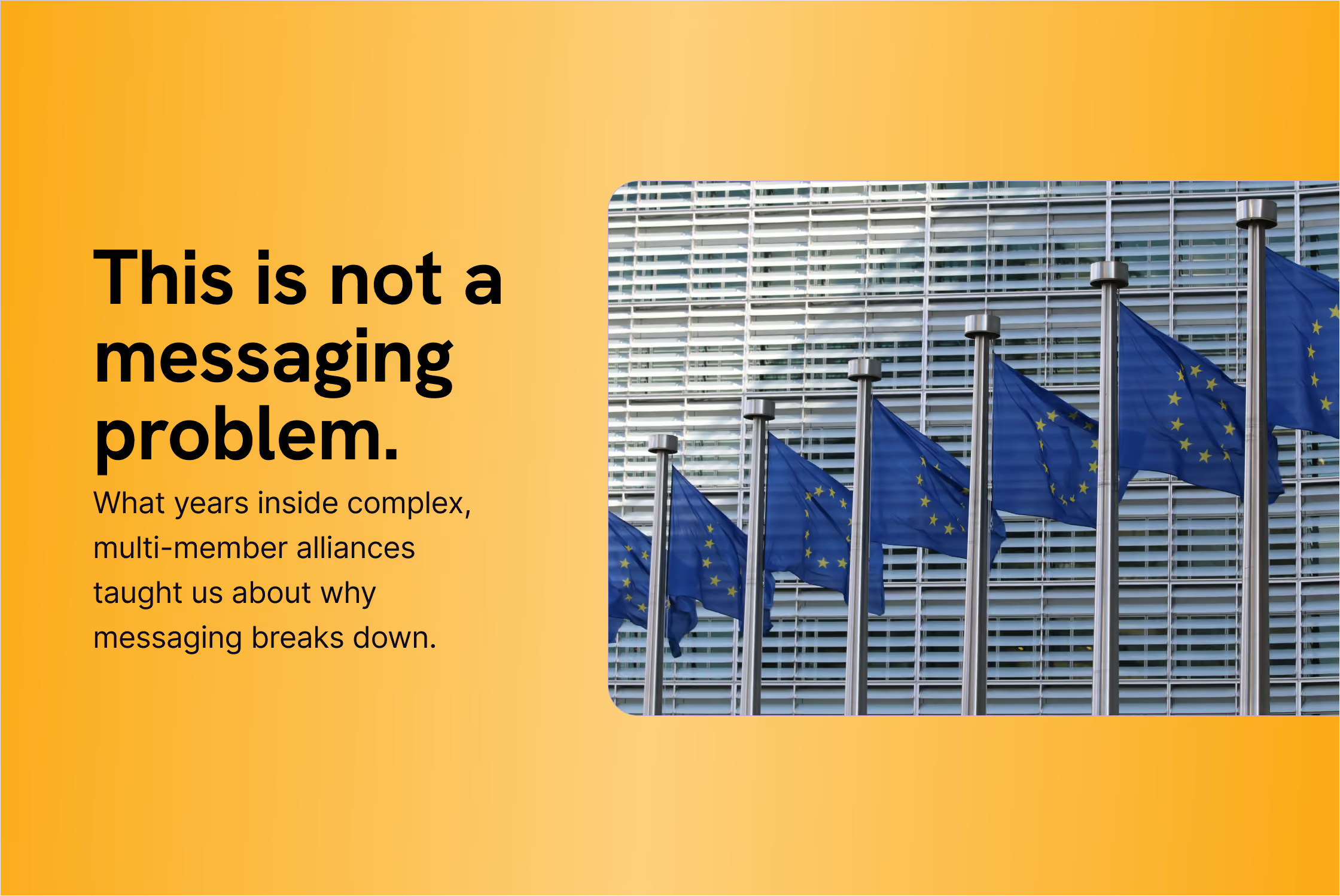
There’s a moment that happens in almost every large association.
It usually surfaces during a board meeting, often towards the end, when someone says, almost as a summary of collective frustration: “We need to communicate this better.”
The secretariat agrees. Members nod. The solution feels obvious. A new newsletter is drafted. A refreshed LinkedIn strategy is discussed. Sometimes the conversation escalates into a rebrand.
And yet, a few months later, the same sentence returns - perhaps with a new logo attached to it.
Because the issue was never the channel or the old logo. It was that no one had fully agreed on what needed to be communicated in the first place.
Members sit under one umbrella, but not for the same reason
Over the years, we have worked inside large, cross-industry alliances in Brussels. The kind that look perfectly coherent from the outside, but are anything but simple once you step in.
Members join with different commercial realities. Some are global corporations with regulatory exposure across continents. Others are niche specialists focused on a narrow segment of the value chain. Some compete directly with each other. Some operate upstream, others downstream.
They all sit under one umbrella. But they do not join for the same reason.
One member is interested in regulatory influence.
Another wants visibility.
Another wants access to intelligence.
Another simply wants to monitor competitors and stay close to policy developments.
And yet the association must set common priorities, communicate unified positions and create shared value.
That tension shapes everything.

Why it looks like a messaging problem (and why that diagnosis is wrong)
From the outside, when communication feels diluted or generic, it is tempting to treat it as a messaging issue.
Why is the narrative not sharper?
Why does the positioning feel vague?
Why does the website sound like it could belong to anyone?
Inside the organisation, however, the reality is more structural.
If priorities are not aligned, messaging cannot be aligned. If value is not clearly defined, communication becomes abstract. If the roles between board and secretariat are blurred, decisions stall. And when decisions stall, language becomes cautious.
Cautious language produces forgettable communication.
Communication is the visible expression of governance
This is where many associations get stuck. They invest in output before they invest in structure.
More content.
More formats.
More updates.
The output increases, but the friction underneath remains.
Communication in associations is not marketing in the traditional sense.
It is the visible expression of governance. And if governance is fragmented, communication will be fragmented.

What the associations that communicate well do differently
We have seen alliances where strategy exists on paper but is not translated into operational priorities. Where operational realities are not explained upwards. Where members expect different things, but those differences are never explicitly named.
In those environments, even the most carefully designed communication system struggles. Design can clarify complexity, but it cannot compensate for structural ambiguity.
The associations that communicate well are not necessarily louder or more active. They are clearer. Clear about what they stand for. Clear about what they prioritise. Clear about what members can expect. Clear about who decides what. When that internal architecture is strong, messaging becomes simpler. Tone becomes more confident. Content becomes more consistent. Not because someone suddenly writes a better copy, but because alignment exists underneath it.
For Brussels-based associations, this is not cosmetic. Credibility depends on coherence. Policymakers notice when positions shift or feel diluted. Members notice when value sounds abstract or interchangeable.
Communication is not a finishing touch. It reflects how well an organisation knows what it stands for. And that alignment is strategic work.
If your association’s communication constantly feels like it needs fixing but never truly stabilises, the question may not be how to communicate better.
It may be what you are not yet aligned on.
That is where the real work begins.
If you recognise this pattern inside your association, it may not be a content issue. It may be structural. We help associations untangle that layer before redesigning the surface.